


Rural communities across Scotland are finding themselves subjected to an increasingly heavy handed, top down planning regime that leaves little room for meaningful local influence. Many of us began by signing petitions, believing that collective objection might be enough. It quickly became clear that this was only the starting point. Of all the MSPs we contacted, Craig Hoy was the one who engaged directly. Following a constructive online meeting, it became evident that he has already attempted, and continues to push, for a moratorium on further renewable infrastructure in Dumfries and Galloway. His efforts, however, expose a deeper problem. Real decision making power does not sit with communities, nor even with most elected representatives, but with Ministers at the heart of the Scottish Government.
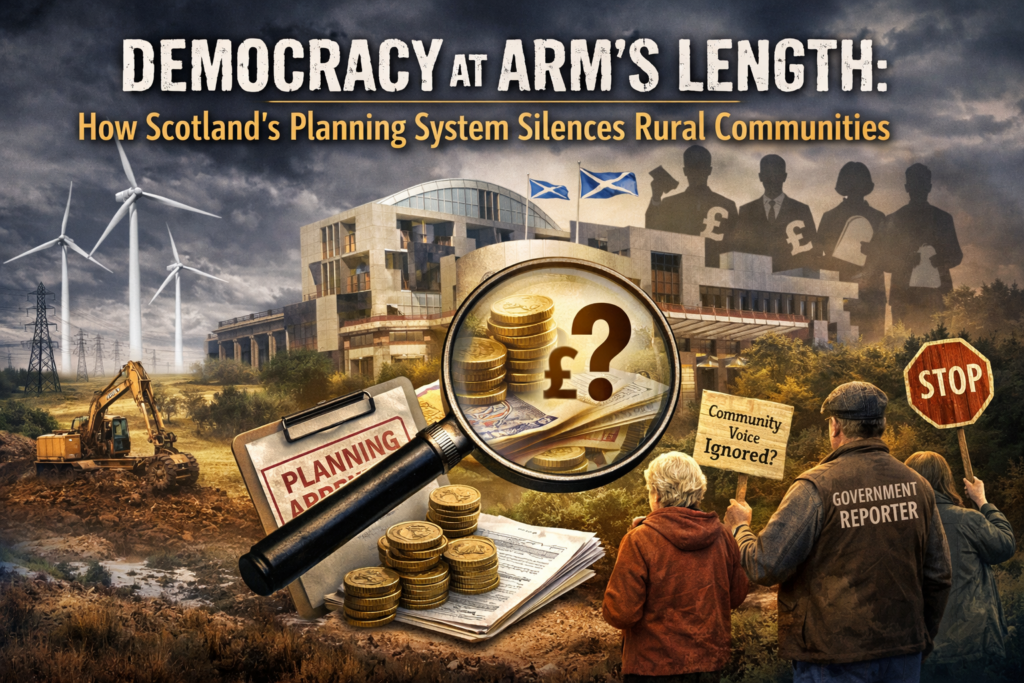
From the perspective of rural residents, it often feels as though communities are viewed in Holyrood as an inconvenience rather than stakeholders. Objections are tolerated but rarely heeded. Landscapes that have shaped local identity for generations are treated as expendable, and those who speak up are dismissed as obstacles to national policy rather than participants in a democratic process.
What has become clear over time is just how tightly controlled the planning system really is. Community consultations frequently amount to little more than a procedural formality. Even where a Community Council formally objects, and even where Dumfries and Galloway Council itself raises objections, the application can still be approved. Ultimate authority rests solely with Scottish Ministers. Local democracy, in practice, is overridden by centralised decision making. This raises a fundamental question about how such a system was ever deemed acceptable in a country that claims to value community empowerment.
The Dalmacallan proposal sits within the Section 36 regime, applying to developments above 50 megawatts. With up to 16 turbines reaching 200 metres to blade tip, the maximum installed capacity is stated as 115.2 megawatts. This places the project within the 100 to 300 megawatt band, attracting a planning fee in the region of £216,000. On paper, this appears substantial. In reality, it prompts serious questions. Does this sum genuinely cover the vast amount of work required to assess such an application properly? The process involves not only meetings and paperwork, but extensive site visits, independent reporting, legal scrutiny and the involvement of specialist planning consultants.
Historically, if a proposal of this scale was rejected by the local authority, it would proceed automatically to a Public Local Inquiry, requiring significant legal representation and further expense. That process has now changed. Applications are first passed to a Reporter, not a journalist, but a government employed official tasked with assembling the full case and forming a professional judgement on the competing arguments. That Reporter then decides whether a Public Local Inquiry is necessary. If it is, costs escalate further for all parties involved, including the council, the Energy Consents Unit and, crucially, the communities who are already giving their time and resources simply to be heard.
The question that remains unanswered is whether the planning fee paid by the developer truly reflects these cumulative costs, or whether the financial burden is quietly shifted onto public bodies and local people. When communities are forced to fundraise, self educate and seek legal advice simply to engage with a system stacked against them, transparency becomes essential. The next step is unavoidable. It is time to follow the money.
Leave a Reply